Nearly every animal alive is a variation on a single body plan that is roughly half a billion years old: a tube inside a tube, moving through space, taking in material at one end and passing waste out the other. Everything else — limbs, jaws, eyes, brains, sonar — is modification layered onto that design: worms with extensions.
This is not a metaphor or a simplification for beginners. It is close to the standing position in animal phylogeny and developmental biology, and the evidence for it is genetic rather than anatomical: the instructions that lay out a body from head to tail are the same instructions in a fly, a worm, and a whale, arranged in the same order, doing the same job.
This article lays out the claim, the evidence, the mechanisms by which the plan gets modified, and the boundaries where the claim stops being true. It also builds the genetics from the ground up, because the genetic evidence is the load-bearing part and it is usually written for people who already know it.
Where this came from
This article works through a proposal that arrived from outside biology, reasoned out from watching whales feed — specifically the way a rorqual rises toward a swarm of krill, opens its mouth just far enough to engulf the volume of water the krill occupy, and closes it with precision. Watched closely, the animal stops looking like a mammal and starts looking like a worm.
The question underneath was never really about whales. It was: what is a human, and what is life?
The proposal, in the terms it was originally put:
- A cylinder within a cylinder. Something that moves through space, taking in the particles the system needs in order to keep running. “Worm” names that shape rather than a group of animals — the claim is that the ancestral form, if it could be seen, would look like a worm to an observer. A whale’s lunge is that same process made briefly visible: take in material, keep what is useful, expel the rest.
- Evolution as complexity added to something already running. Layers keep being added and genes keep being extended, with each change made to a creature that already exists, in response to whatever was happening in the world at the time.
- Limbs as one section duplicated. Arms and legs look like the same code extended more than once, and the fingers repeat the pattern of the arms. Part of the claim is that the pattern is visible — you can look at your own limb and see how it could be built.
- Every material descends from an ancestor that had the potential for it. Bone, hair, every structure — elaborated rather than newly invented, with different lineages pushing different parts further according to what helped them survive.
- Sense organs as the intake principle applied to information. An eye takes in information; so does sonar. Neither departs from the cylinder — both exist so it can locate what it needs.
Everything below tests that against what is currently known.
Where each part is taken up
What the cylinder is, and which animals count as one — section 2. The claim that “worm” names a shape rather than a group of animals is the first thing that has to be pinned down, because the whole proposal depends on it.
The limb duplication — sections 4 and 5. This turns out to be the strongest of the observations: duplication is literally what happened, at three separate levels, and one of them is the whole genome.
Layers added to something already running — section 6. Correct as a strong bias, with a specific boundary on where it stops holding.
Sensing as intake applied to information — section 7. The light-detecting machinery predates the animals that use it, and the eye has been rebuilt independently more than once.
The whale, worked through in full — section 8. Lunge feeding, the anatomy that serves it, and why the gape reads as ancient.
What kind of object has to keep running for any of this to work — section 9.
What is genuinely unsettled — section 10.
What the claim actually says
”Worm” is not a group of animals
There is no branch of the tree of life called Worms. Flatworms, roundworms, ribbon worms, peanut worms, acorn worms, velvet worms, arrow worms, horsehair worms, and segmented worms belong to separate phyla divided by hundreds of millions of years of independent evolution. Biologists keep reusing the word because the same shape keeps appearing and keeps being retained.
That reuse is informative. A shape that arises repeatedly and independently, and that persists in lineage after lineage, is not a specialization. It is what animals default to when nothing pushes them elsewhere.
The actual definition
What the word informally names is a set of features that appear together:
- Bilateral symmetry — a left and a right, and therefore a front and a back.
- A through-gut — a digestive tube running the length of the body, with a mouth at one end and an anus at the other. Material enters, is stripped of what is useful, and exits. This is the tube-within-a-tube.
- A defined head-to-tail axis — positions along the body are distinct and specified.
- Three tissue layers in the embryo, including a middle layer that produces muscle and internal organs.
- Nervous tissue concentrated toward the front, where new information arrives first.
Read without prejudice, a human satisfies every clause. So does a blue whale. What is casually called “not a worm” means a tube with enough hardware attached that the tube is not the first thing an observer notices.

The plan in question. Mouth at one end, anus at the other, gut running between them inside an outer body wall, nerve tissue thickened toward the front.
Who this covers, and who it does not
The group defined by these features is Bilateria, and it accounts for roughly 99% of living animal species across about 32 phyla.
The exceptions are a short list: sponges, comb jellies, cnidarians (jellyfish, corals, anemones), and placozoans. None of them has a front and a back in the sense used above, and none is patterned by the positional gene system described in section 4.
The gut is a messier boundary than it looks. Sponges and placozoans have no gut at all, and a jellyfish’s single opening does serve as both mouth and anus. Comb jellies, though, turn out to have a real through-gut: live imaging published in 2016 tracked food passing all the way through and waste leaving by two functioning anal pores, overturning a long-standing textbook claim that they had a blind sac. So a through-gut is not by itself what marks out the group in question, and it may well be older than that group. Bilateral symmetry and the head-to-tail gene system are what do the marking.
Which of these branched off first has been contested for decades. The strongest current evidence comes from a 2023 analysis that compared not gene sequences but chromosome structure — which genes sit together on which chromosomes. The reasoning is that chromosome fusion-and-mixing events are rare and effectively irreversible, so shared arrangements are very hard to produce by coincidence. That analysis found sponges sharing derived chromosomal rearrangements with bilaterians and cnidarians, while comb jellies retain the ancestral arrangement alongside single-celled relatives of animals. The conclusion is that comb jellies are the sister group to all other animals.
So the shape of the tree is: animals split near the root, one branch became comb jellies, the other branch eventually produced the tube — and that branch became almost everything.
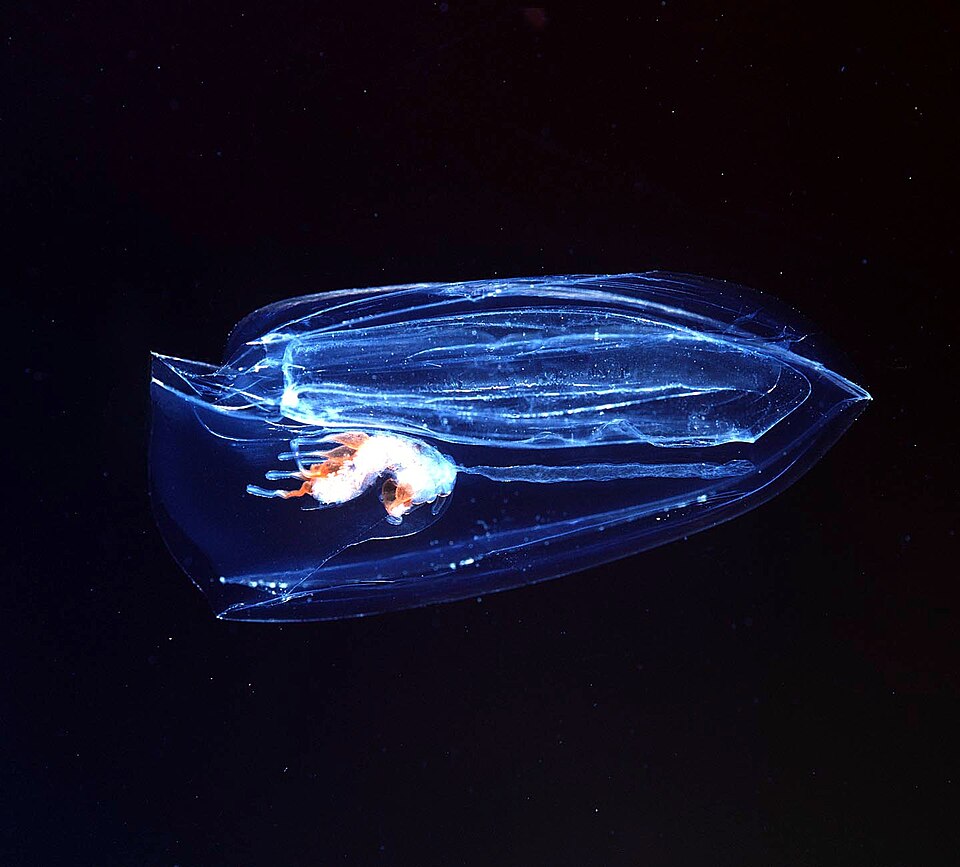
A comb jelly — outside the body plan in question: no head-to-tail axis, and none of the positional genes that build one. It does have a working through-gut, confirmed only in 2016. On current evidence this lineage branched off before every other animal. — Uwe Kils, ed. Arne Nordmann, CC BY-SA 3.0
Enough genetics to read the evidence
The rest of this article depends on understanding what a gene does. This section builds that from nothing. Anyone already comfortable with transcription factors can skip to section 4.
DNA is a sequence, and that is all it is
DNA is a very long molecule built from four repeating chemical units strung end to end. The units differ from each other only slightly, and the molecule’s function does not come from any special property of the units themselves. It comes from their order — the same way the letters of an alphabet carry no meaning individually but carry everything in sequence.
A gene is a stretch of that sequence.
Genes are read to produce proteins
Proteins are the working material of a body. They are the enzymes that run chemistry, the fibers that make up structure, the pumps in cell membranes, the receptors that detect things. Almost everything an organism physically is or does is protein doing it.
A protein is a chain of smaller molecules called amino acids, folded into a specific three-dimensional shape. The shape is the function. A protein works by fitting against something — binding it, cutting it, holding it, letting it through. Change the shape and the function changes with it.
This is why single-letter changes in DNA matter. One change in the sequence swaps one amino acid for another; that swap can alter the fold; the altered fold behaves differently. It is a small chemical difference with a large functional consequence, and it is the reason single mutations can have visible effects.
A gene, then, is a stretch of sequence that spells out a protein. Two honest simplifications sit in that sentence: some genes are read into RNA that does its job as RNA and never becomes a protein at all, and one gene can often be read in several ways to produce several related proteins. Neither changes anything that follows.
The important part: cells read only some of their genes
Every cell in a body carries essentially the same DNA. A liver cell and a neuron have the same genes. They differ because they are reading different ones.
Which genes a cell is currently reading is called gene expression. This is the central concept. The interesting question in development is never “what genes does this animal have” — it is “what determines which genes get read, in which cells, at which time.”
Most of the interesting genes are switches
Some proteins do not build anything. They bind to DNA near other genes and turn those genes on or off. These are transcription factors, and functionally they are switches.
Switches can control other switches. A single switch flipping on can activate a set of downstream switches, each of which activates more. A very small number of top-level switches, arranged in a cascade, can specify an enormous amount of structure — because the structure is not encoded anywhere as a picture. It is produced by a sequence of decisions.
This is what statements like “gene X determines hindlimb identity” actually mean. Gene X is not a blueprint of a leg. Gene X is a switch that, when on, routes a generic developmental program down the leg branch instead of the arm branch. The program is shared. The switch selects.
Once this is in place, the rest of the evidence is readable.
The positional switches, and why they are the evidence
Shape similarity between animals is weak evidence — unrelated lineages converge on similar shapes constantly. The strong evidence that all bilaterians run one body plan is that the control software was never rewritten.
Hox genes assign position
A specific family of switch genes, the Hox genes, assigns identity along the head-to-tail axis. Their job is to tell a region of the embryo where it is: this region is jaw, this region is neck, this region is lumbar, this region is tail. They do not build the structures. They tell each region which structure to build.
That they exist at all is notable. That they are organized the way they are is the actual finding.
Colinearity
Hox genes sit together on the chromosome in a cluster. The physical order of the genes along the DNA matches the order of the body regions they specify. The gene at one end of the cluster controls the front of the animal; the gene at the other end controls the rear; the genes in between control the regions in between, in sequence.
There is no engineering requirement for this. The cell does not read the chromosome like a strip of film. The genes could be scattered across different chromosomes and still work — and in some lineages the cluster has broken up. But the ancestral arrangement is an ordered cluster, and it has been held together for an extraordinarily long time.
This arrangement — called spatial colinearity — is found in fruit flies, in mice, in marine segmented worms, and in acoels, among the simplest bilaterians alive. Mammals carry 39 Hox genes across four clusters, with the genes at one end of each cluster acting toward the head and those at the other end acting toward the tail.
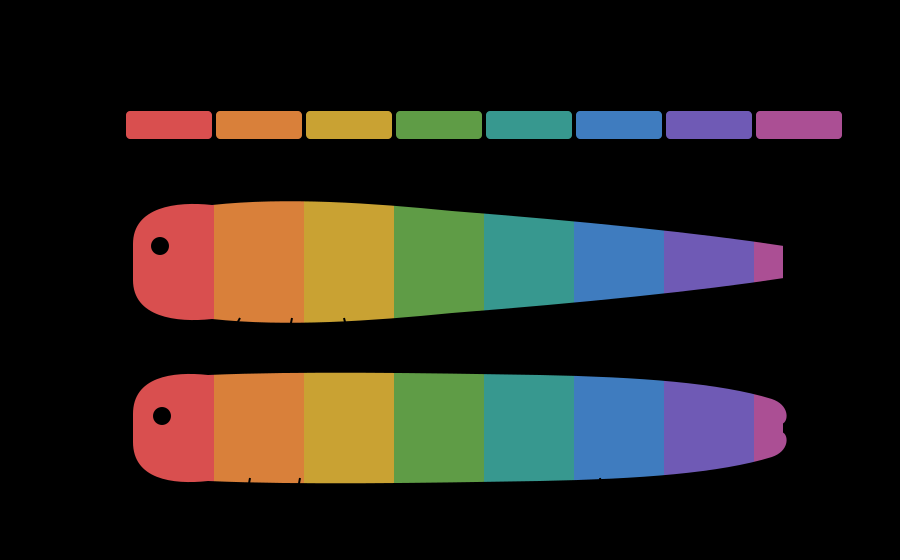
Schematic. The genes sit on the chromosome in the same order as the body regions they control, and the ordering is the same in animals as different as a fly and a mammal. Drawn with one cluster for clarity; vertebrates carry four.
What this establishes
An animal is not tube-shaped by coincidence of engineering. It is tube-shaped because it is patterned by tube software that has not been meaningfully rearchitected in roughly half a billion years.
The body plan is conserved because the thing that specifies it is conserved. And the thing that specifies it is conserved because everything built afterward depends on it.
The four ways a body plan gets modified
If the core is frozen, all evolutionary change has to happen somewhere else. There are four recurring moves, and between them they account for most of what makes one animal look different from another. This is the general mechanism, and it is more useful than any individual example of it.
Move one: duplicate the code
When a stretch of DNA is copied, the organism ends up with two versions of a gene where one will do. The spare is free from selective pressure — the original still does the job — so it can accumulate changes that would otherwise be fatal. Over time, the copy takes on a new function.
This happened at the largest possible scale in the vertebrate lineage. Invertebrates typically carry one Hox cluster. Vertebrates carry four. The standard explanation is that the entire genome duplicated, then duplicated again, in the vertebrate stem lineage more than 450 million years ago, followed by extensive loss of redundant copies. That 1:4 ratio was the original evidence for it. The details remain debated — some analyses support one round rather than two — but duplication followed by divergence is not in dispute as a general mechanism.
The consequence: a great deal of vertebrate complexity is not new invention. It is old instructions, copied, with the copies repurposed.
Move two: redeploy the code somewhere new
A program that patterns one thing can be run a second time in a different location.
Limbs are the clearest case. The Hox cluster that patterns the main body axis is deployed a second time inside the limb bud, which grows out sideways from the body and has its own organizing center and its own axes. A limb is, structurally, a small body axis running off the side of the big one.
The internal architecture reflects this. Arm and leg share the same plan: one bone, then two bones, then many. Humerus, then radius and ulna, then wrist and hand. Femur, then tibia and fibula, then ankle and foot. These are serially homologous — iterated structures running one shared program twice.

The same sequence of parts, run twice. One bone, then two, then many — in the arm and in the leg alike.
Move three: flip an identity switch on top of a shared program
Forelimb and hindlimb are not two designs. They are one limb-building program with a small set of identity regulators layered on: Tbx5 marks forelimb, Tbx4 and Pitx1 mark hindlimb.
The revealing detail is that forelimb identity is largely the default. Hindlimb identity is imposed on top, through a repressor function specific to Tbx4. It is not two programs; it is one program plus a modifier.
And the modifier can be moved. Forcing Pitx1 expression in a developing forelimb transforms the muscles, tendons, and bones of that limb toward hindlimb morphology. One switch, in the wrong place, converts an arm toward a leg.
Move four: repeat a unit, and tune the spacing
Bodies are full of repeated parts — vertebrae, ribs, segments, digits. These are not carved out individually. They are generated by mechanisms that produce regular spacing automatically, and evolution modifies the spacing rather than the parts.
The mechanism is worth understanding concretely, because it is unintuitive. If two substances diffuse through a tissue at different rates, one promoting a structure and one suppressing it, the two can settle into a stable pattern of regularly spaced peaks and troughs — with no template telling any particular spot what to become. The spacing emerges from the chemistry. This is a reaction–diffusion or Turing mechanism, and it is the same class of process that produces spots on a leopard and stripes on a zebra.
Digits are made this way. The distal Hox genes do not specify individual fingers; they set the wavelength of the pattern — how far apart the peaks fall. Progressively reducing the dose of those genes in mice produces progressively more digits, thinner and more densely packed. Turning the dose down shortens the spacing, so more fingers fit in the same width of tissue.
A hand is a standing wave with a frequency control on it.
The same class of mechanism, at a different scale, produces the repeated blocks that become vertebrae and ribs. Which means the repetition trick runs at three nested levels: along the body, along each limb, and again at each limb’s tip.

Digits appear at the peaks of a chemical pattern. Shorten the spacing and more of them fit across the same tissue. Reducing the distal Hox dose in mice is the direction that has been demonstrated.
Where change is cheap, and where it is not
The four moves explain how modification happens. A separate question is where on an organism it happens — and the answer is consistent enough to be a rule.
The middle of development is nearly frozen
Embryos within a phylum look fairly different early on, converge toward a similar form partway through development, and then diverge again as they finish. The point of maximum similarity is called the phylotypic stage, and the overall pattern is the developmental hourglass.
This was long a morphological impression. It now has direct genomic support: two independent analyses in 2010 found that the phylotypic stage expresses the oldest and most evolutionarily conserved set of genes in the entire life cycle. The middle of development is where the ancient machinery runs.
The model is not settled, and it would be wrong to present it as though it were. The phylotypic stage has never been given a precise, measurable definition — it was originally picked out by eye, and largely in a handful of popular laboratory species. At least one quantitative study of vertebrates found variation between species highest in mid-development, which is the opposite of the prediction, and a 2019 analysis of animals with spiralian development found no hourglass in their gene expression at all. The narrower claim this article rests on is the well-supported one: early and mid-development are heavily constrained relative to late development. Whether the waist is as sharp, or as universal, as the picture implies is still argued.
(This is not the discredited nineteenth-century idea that embryos replay their ancestors’ adult forms. They do not. The correct claim is narrower: early and mid-development are conserved across related species, and the conservation is strongest in the middle.)
The reason is dependency
Early and mid-development are almost unmodifiable because everything built afterward rests on them. A change to a step that a thousand later steps depend on is not a small change — it is a change to all thousand. Such mutations are overwhelmingly fatal, and so they do not persist.
Variation therefore accumulates where it is affordable: late in development, and at the periphery. Terminal structures. Surfaces. The outside.
This is what gives the layered appearance. Layers accumulate on the outside not because evolution has a tendency to add, but because the outside is the only place where a change can be paid for.

Species differ early, converge in the middle, and diverge again at the end. The waist is where the oldest genes are running.
But the direction is not one-way
The layered-accumulation picture fails badly if taken as a law, because subtraction is just as normal and often faster:
- Whales lost their hind limbs entirely; the pelvis is reduced to bone with no limb attached.
- Snakes lost their limbs.
- Cave fish have regressed their eyes independently, in many separate lineages — while enhancing other senses, expanding the lateral line and multiplying taste buds.
- Subterranean mammals have inactivated eye-specific genes outright.
- Parasites shed enormous fractions of their gene content.
The accurate rule is not layers get added. It is: the periphery is where change is cheap, in both directions. Structures get bolted on there and stripped off there with roughly equal ease. What is protected is the core, and the core is the tube.
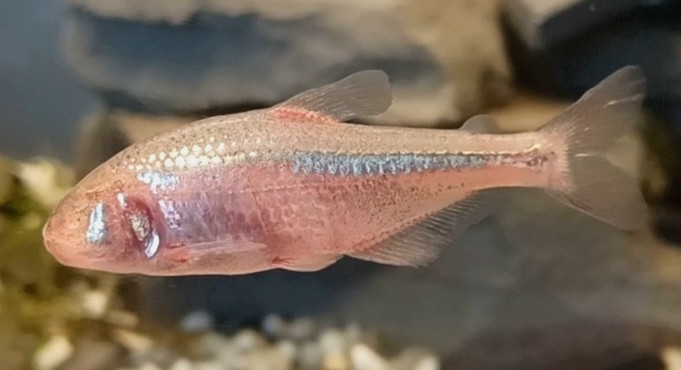
A blind cave tetra. Eye loss has evolved independently in many cave lineages, alongside enhancement of the senses that still work. Subtraction is as ordinary a move as addition. — Seb Morič, CC BY-SA 4.0
The tube’s instruments
Sense organs fit this framework without needing a separate account. An eye and a sonar system are the same functional object: a mechanism for detecting where useful material is, so the tube can go to it. Both take in a signal that has interacted with the world and reconstruct the world from it. One uses light that was already there; the other emits its own sound and reads the return.
Three findings show how deep the reuse runs.
The ancestral animal already had the light-detecting cells
The marine ragworm Platynereis carries two distinct photoreceptor types: one in its eyes, and another in its brain that uses a light-sensitive protein closely related to the ones in vertebrate rods and cones. Comparative analysis indicates both cell types were present in the last common bilaterian ancestor. The ancestral cell type of the vertebrate retina existed inside a worm’s brain before anything resembling a vertebrate eye did.
The instruction for building an eye is shared across the whole group
A single control gene — Pax6 in vertebrates, eyeless in flies — is conserved across insects, vertebrates, cephalopods, sea squirts, and ribbon worms. Forcing the fly version to express in the wrong developing tissue induces structurally normal eyes on wings, legs, and antennae, complete with differentiated photoreceptors. It is a switch that means build an eye here, and it still functions when pointed at a leg.
The same solution gets rebuilt independently, down to individual amino acids
Prestin is a protein in the inner ear that sets sensitivity to high frequencies. In echolocating bats and in toothed whales — lineages far apart in mammal phylogeny, one hunting in air and one in water — it shows extensive convergent substitutions: 34 of the 56 amino acid changes in toothed whales match changes found in echolocating bats. At one position, every echolocating mammal carries one amino acid and every non-echolocating mammal carries another, a parallel change on both ancestral branches; functional testing confirms that this single substitution accounts for the shared performance shift.
Two lineages, facing the same problem in different media, arrived at the same mutations.
One boundary on that claim is worth stating, because the wider version of it was wrong. A 2013 paper reported genome-wide protein convergence across echolocating mammals; a 2015 reanalysis showed the apparent signal was an artefact of the null model used, finding no genome-wide convergence for echolocation. What survived the reanalysis is the narrower result used here — strong, functionally confirmed convergence at prestin and a small number of other hearing genes, not across the genome at large.
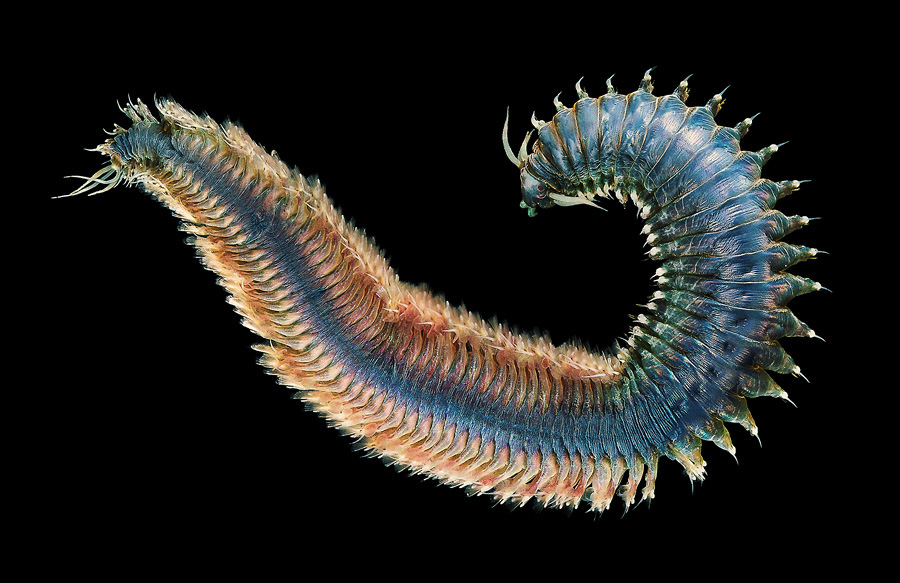
A nereid ragworm, the group Platynereis belongs to. Animals like this carry light-detecting cells in the brain that use proteins closely related to those in vertebrate rods and cones. — Alexander Semenov, CC BY 2.0
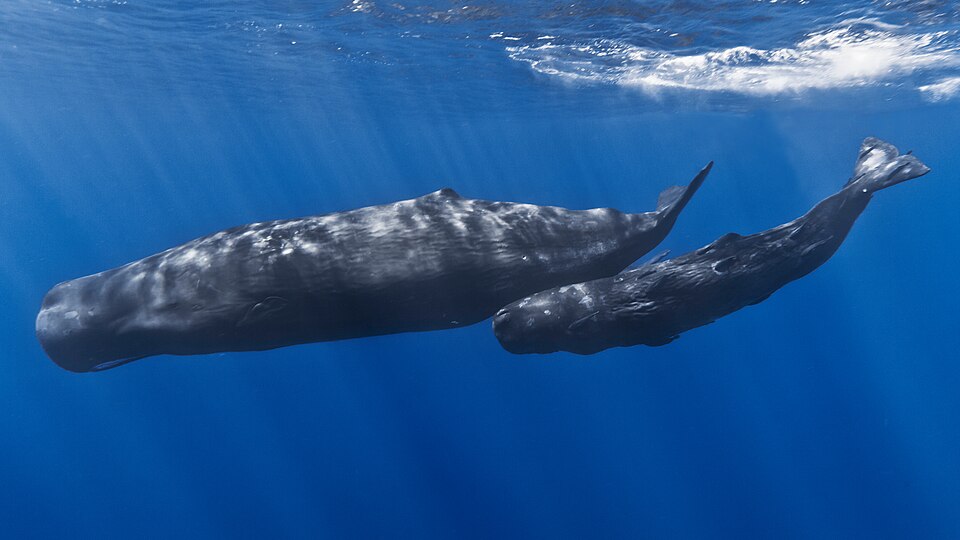
A sperm whale. Most of that head is not brain but acoustic apparatus — the organ that generates and aims its clicks. Vision and echolocation solve the same problem in different media. — Gabriel Barathieu, CC BY-SA 2.0
A worked example: the rorqual whale
Rorquals — blue, fin, humpback, minke — demonstrate every part of this framework at once, and at a scale that makes the mechanics visible.
Lunge feeding
A rorqual feeds by accelerating toward a dense aggregation of krill and opening its mouth to a maximum gape near 80°, with jaw joints permitting close to 90°. The pressure of the water forces the throat pouch open. The full cycle — open, engulf, close — takes about six to seven seconds.
The volumes stop being intuitive. Engulfment capacity runs from roughly 500 litres in a 5-metre minke to over 150,000 litres in a 28-metre blue whale. The animal takes in a mass of water that can exceed its own body mass. It is not opening a mouth so much as converting its front half into a bag and letting inertia fill it.
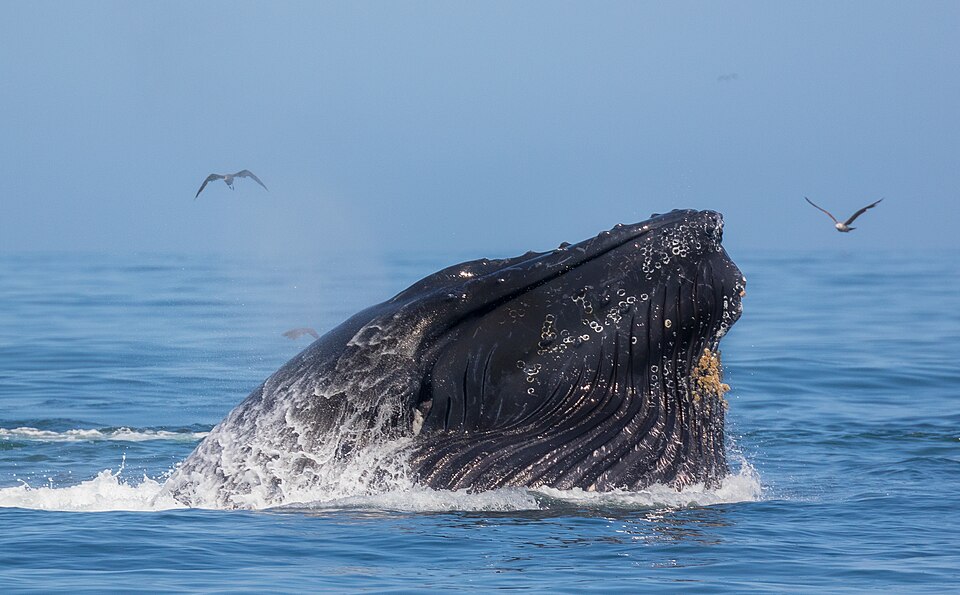
A humpback lunging. The throat pleats are visibly distended and the baleen fringe is exposed along the upper jaw. The whole cycle takes about six to seven seconds. — Gregory “Slobirdr” Smith, CC BY-SA 2.0
The anatomy that serves it
The rorqual’s lower jaw is unfused — there is no bony joint at the chin, only fibrous tissue, so the two jaw bones can rotate outward independently.
Inside that fibrous joint sits a sensory organ, described only in 2012, built from the vascular and nervous tissue of the ancestral front tooth socket — a tooth position that, after teeth were abandoned entirely, was repurposed into a measuring instrument. It carries mechanoreceptors that track jaw rotation and throat expansion in real time, mechanically linked to the expanding throat grooves, and it supplies the signal the brain needs to time the start, middle, and end of the lunge. Right whales and grey whales, which feed by other methods, do not have it.
This is move one and move two of section 5, visible in a single structure: an existing part, freed from its original job, redeployed as something else.
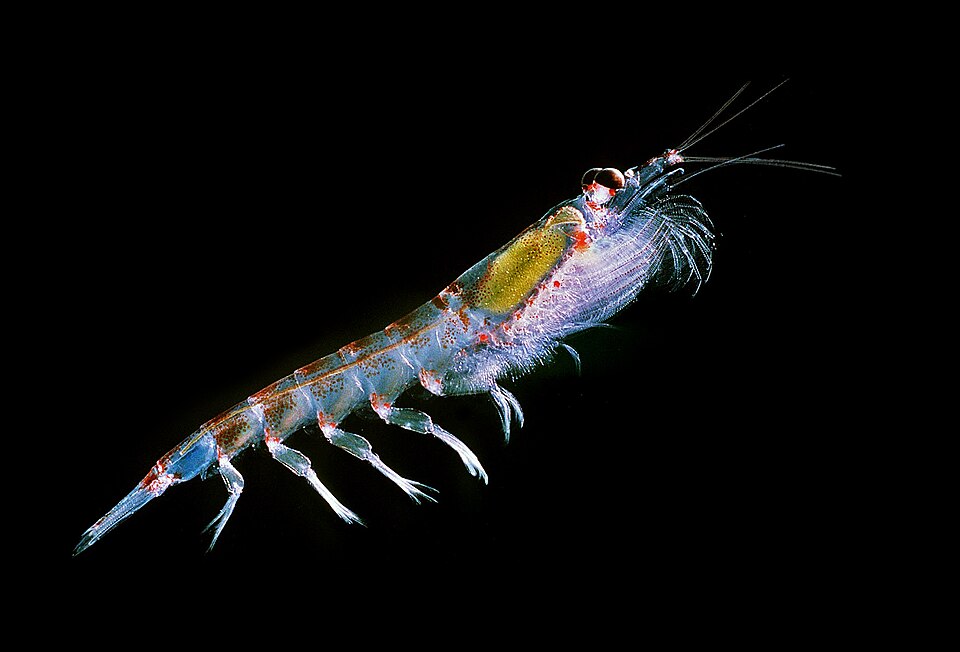
Antarctic krill. A blue whale engulfing 150,000 litres of water is filtering for animals this size. — Uwe Kils, CC BY-SA 3.0
Why the gape reads as ancient
Most vertebrates keep the tube concealed behind a face — jaws, lips, a snout, an expression. For those six seconds a rorqual sets all of that aside and becomes the underlying object: an aperture at the front of a tube, opening, engulfing, closing. The elaborations go quiet and the substrate is briefly visible. The resemblance to a worm is not superficial similarity; it is the same structure, running at 150 tonnes.
The largest animal that has ever lived feeds like the simplest chordate
Amphioxus, the lancelet, is a small translucent animal with a stiffening rod, a nerve cord, a tail — and essentially no head. It feeds by driving water through its mouth with beating cilia across roughly 100 slits in its throat, while a glandular groove called the endostyle secretes mucus that traps particles down to sub-micron size. The perforated throat of early chordates is thought to have originated for filtering food; gas exchange — gills in the modern sense — was added much later.
Two consequences are worth holding together.
That endostyle is the evolutionary origin of the thyroid gland. The organ that regulates vertebrate metabolism began as a mucus dispenser for catching food.
And baleen whales converged back onto the same strategy — extracting small particles from bulk water — by an entirely different route. Baleen is not part of the throat. It is keratin: skin-derived material, the same class of substance as fingernails, grown into a filter. The whale did not inherit the ancestral apparatus. It rebuilt the ancestral function out of whatever tissue was nearest.
The convergence is strong enough to have been reached from outside the lineage. The Early Triassic marine reptile Hupehsuchus independently evolved a skull with baleen-whale-like proportions for filter feeding, long before whales existed. Bulk-filtering water is not a whale strategy; it is what a chordate does when circumstances allow, at whatever size it happens to be.
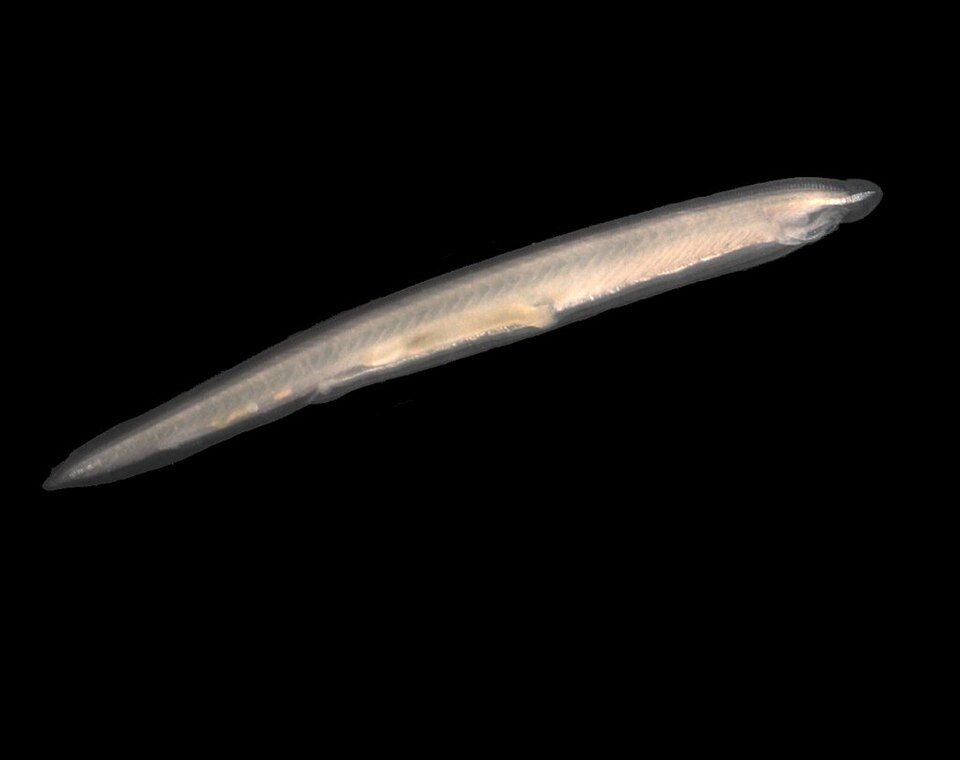
A lancelet. No jaws, no head to speak of — it filters particles from water drawn through slits in its throat. This is close to the ancestral chordate way of feeding, and the whale reinvented the function out of skin. — Hans Hillewaert, CC BY-SA 4.0
And the extensions came off
Whale ancestors were four-limbed land mammals. They returned to the water, and early whales still carried small external hind legs. Modern whales have no external hind limbs at all — only a reduced pelvis with no limb attached to it.
Those pelvic bones are not simply leftovers, though. They anchor the muscles that control the penis, and their size and shape track the intensity of sexual selection across species, which is probably why they were never lost outright. The limb went; the bone was kept and put to another use — move two of section 5, running one more time.
The limbs were an extension. The extension was removable. The tube was not.

Basilosaurus, an early whale. It still carried small external hind legs. Modern whales have none — only a reduced pelvis, which was retained for an unrelated job rather than simply left over. — J. W. Gidley, 1913, public domain
What the tube is doing
One point of physics clarifies why a tube that takes in material is the right primitive object rather than an arbitrary starting point.
A crystal is an equilibrium structure. It forms because that arrangement is a low-energy state, and once formed it is complete. It consumes nothing and requires nothing. Left alone for a hundred million years it is unchanged. Its order is free.
An organism is a dissipative structure — open, far from equilibrium, existing only while energy flows through it. Its order is not a resting state but a maintained one, paid for continuously, and it collapses within minutes when the flow stops. Flames and convection cells belong to the same physical category; minerals do not. Schrödinger described this in 1944 as an organism staying improbable by importing order and exporting disorder.
This is why intake is not one activity an organism performs among others. It is the condition of continuing to exist at all — the same way burning is not something a flame does but what a flame is.
Predation follows from this without needing a separate principle. An organism must acquire concentrated energy and material. Where those are concentrated in the surrounding chemistry, organisms take them from the chemistry; where they are concentrated inside other organisms, organisms take them from other organisms. Predation is not a distinct kind of process. It is the general process, applied to whichever reservoir happens to be richest.
What is genuinely unsettled
Four open questions bear directly on the claims above. Presenting the framework without them would overstate it.
How complex the ancestor was
Two live hypotheses for the last common bilaterian ancestor. The complex model: a segmented animal with a central nervous system and an anterior brain, a through-gut with a ventral mouth, a body cavity, and a circulatory system — implying that simple modern worms became simple by losing things. The simple model: something closer to a small acoel flatworm, with complexity built independently afterward in separate lineages. This is not settled.
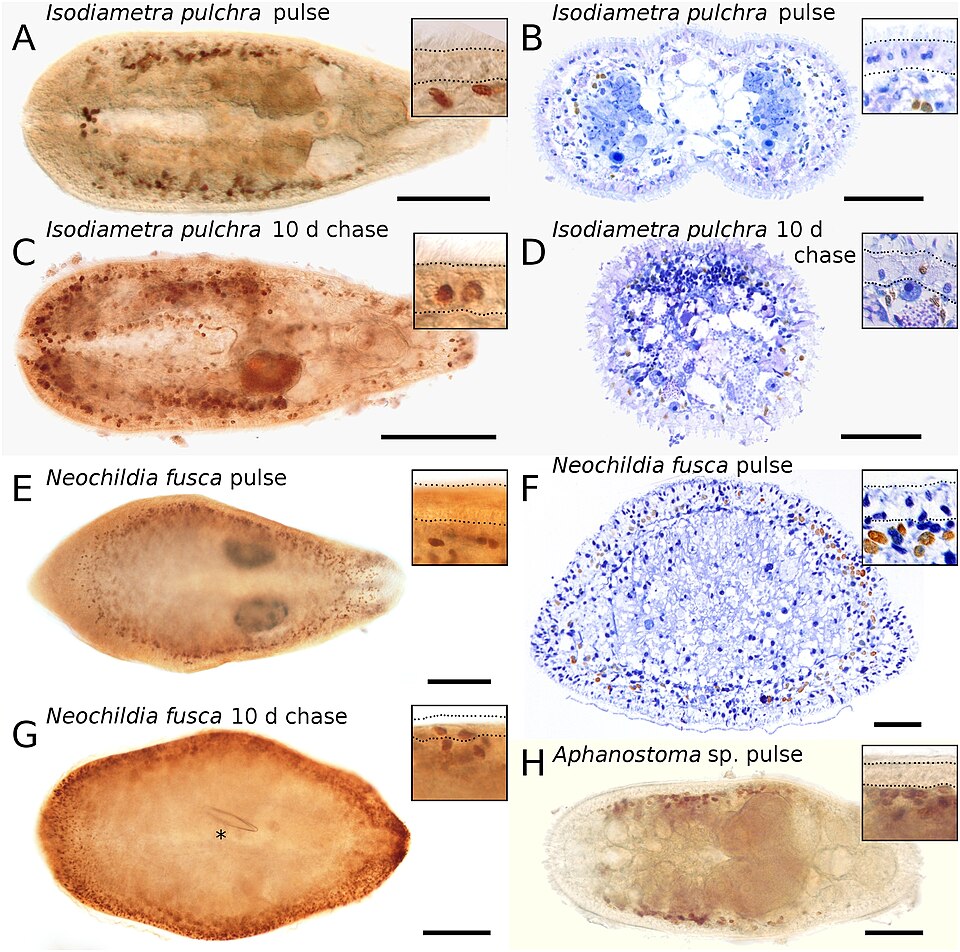
An acoel flatworm. One hypothesis has the ancestral bilaterian looking roughly like this; the competing one has animals like this being simplified descendants of something more complex. — Egger et al., CC BY-SA 2.5
Where the simplest living bilaterians attach
Xenacoelomorpha — the simplest bilaterians alive — sits either as sister to all other bilaterians, or nested inside the deuterostomes near echinoderms and acorn worms. The two placements imply different things: primitively simple, or secondarily simplified. Still contested. A 2024 genome from this group found fully conserved bilaterian toolkits, including Hox clusters, which argues against reading these animals as primitive holdovers.
Whether segmentation has one origin
Vertebrates are segmented, and so are annelids and arthropods, but the repeated blocks that produce vertebrae are a chordate structure absent from other deuterostomes, and homology across the groups is not established. Both lineages use a clock-like mechanism to generate repeats, and some of the same genes appear in both — but this is currently better explained as repeated recruitment of a shared toolkit than as common descent of the trait.
The details of vertebrate genome duplication
That duplication occurred is not in doubt. Whether it was two full rounds, as the four Hox clusters suggest, or one round plus subsequent regional duplications, remains argued.
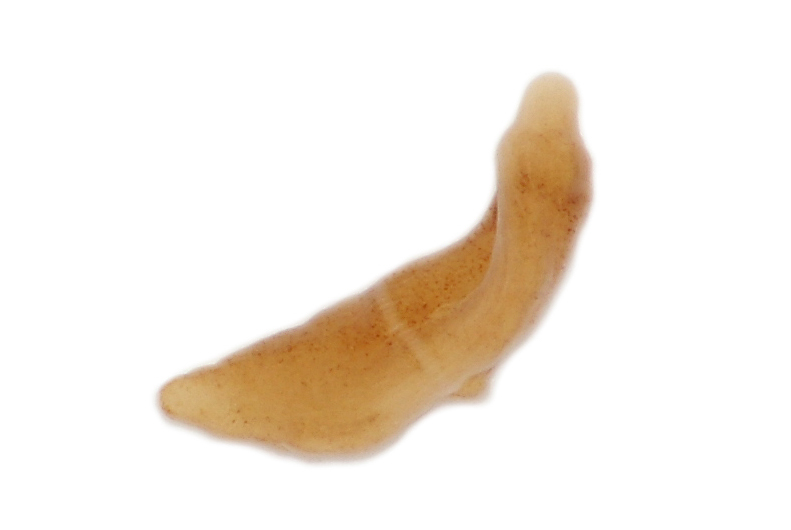
Xenoturbella. Among the simplest bilaterians alive, and still unplaced on the tree — either sister to all other bilaterians, or nested well inside the deuterostomes. — Joacim Näslund, CC BY 4.0
Summary
Animal bodies are one design with modifications layered on. The design is a tube inside a tube with a front, a back, and a direction of travel, and it covers about 99% of living animal species. Its persistence is not aesthetic convergence — it is the direct consequence of the control genes that specify it having gone essentially unchanged for half a billion years, because everything built afterward depends on them.
Modification happens by four repeated moves: duplicating existing instructions so the copies can specialize, redeploying an existing program in a new location, flipping identity switches on top of a shared program, and repeating a unit while tuning its spacing. These moves operate almost entirely at the periphery and late in development, because that is where change is affordable — which is also why structures are lost there as readily as they are gained.
Sense organs are instances of the same pattern: instruments for locating concentrated material, built from ancestral components, reinvented independently whenever the same problem recurs.
A lunge-feeding whale demonstrates the entire framework in six seconds. It is a tube that opens, engulfs a volume of water larger than itself, filters out what it needs through a structure made of skin, and closes — timed by a sense organ built from the socket of a tooth its ancestors stopped growing. Behind the elaboration, the object doing this is the same object that has been doing it, at every scale, since before there were bones.
Sources
Body plan and phylogeny
- Ancient gene linkages support ctenophores as sister to other animals — Nature (2023)
- The Presence of a Functionally Tripartite Through-Gut in Ctenophora — Current Biology (2016)
- Sponges, ctenophores, and the statistical significance of syntenies — MBE
- Xenacoelomorpha is the sister group to Nephrozoa — Nature
- Filtering artifactual signal supports Xenacoelomorpha + Ambulacraria — Current Biology
- A Phylogenomic Backbone for Acoelomorpha — Systematic Biology (2025)
- Segmented Urbilateria: A Testable Scenario — Integr. Comp. Biol.
- The urbilaterian brain revisited — Dev. Genes Evol.
Hox genes, duplication, and limb patterning
- Hox gene colinearity in the annelid Capitella
- Two Rounds of Whole Genome Duplication in the Ancestral Vertebrate — PLOS Biology
- A new look at an old question: when did the second whole genome duplication occur? — Genome Biology
- Tbx5 and Tbx4 genes determine the wing/leg identity of limb buds — Nature
- Divergent transcriptional activities determine limb identity — Nature Communications
- Pitx1 determines the morphology of muscle, tendon, and bones of the hindlimb
- Hox Genes Regulate Digit Patterning by Controlling the Wavelength of a Turing-Type Mechanism — Science (2012)
- Biphasic Hoxd expression in shark fins reveals an ancient origin of the distal limb domain
Developmental constraint and trait loss
- Genomic hourglass — Nature
- Evidence for Active Maintenance of Phylotranscriptomic Hourglass Patterns — MBE
- The Hourglass and the Early Conservation Models — PLOS Genetics
- Inverting the hourglass: quantitative evidence against the phylotypic stage in vertebrate development
- Gene Expression Does Not Support the Developmental Hourglass Model in Three Animals with Spiralian Development — MBE (2019)
- Regressive evolution: limb loss in snakes and eye degeneration in subterranean mammals — MPI-CBG
- Trait Loss in Evolution: What Cavefish Have Taught Us — Integr. Comp. Biol.
- What can vertebrates tell us about segmentation? — EvoDevo
Sensory systems
- Ciliary Photoreceptors with a Vertebrate-Type Opsin in an Invertebrate Brain — Science (2004)
- Induction of Ectopic Eyes by Targeted Expression of the eyeless Gene in Drosophila — Science (1995)
- Convergent sequence evolution between echolocating bats and dolphins — Current Biology
- Parallel Sites Implicate Functional Convergence of the Hearing Gene Prestin — MBE
- No Genome-Wide Protein Sequence Convergence for Echolocation — MBE (2015)
- A functional enrichment test for molecular convergent evolution finds a clear protein-coding signal in echolocating bats and whales — PNAS
Whales and chordate feeding
- Lunge Feeding in Rorqual Whales — Physiology
- Mechanics, hydrodynamics and energetics of blue whale lunge feeding — J. Exp. Biol.
- Discovery of a sensory organ that coordinates lunge feeding in rorqual whales — Nature (2012)
- Sexual selection targets cetacean pelvic bones — Evolution (2014)
- Amphioxus as a model to study the evolution of development in chordates — eLife
- Thyroid and endostyle development in cyclostomes — BMC Biology (2022)
- Cranial convergence between Hupehsuchus and baleen whales — BMC Ecol. Evol.
Thermodynamics